

Emotional Regulation Toolkit
Understanding Feelings Through Everyday Emotion Modes
Many children know they feel something but struggle to explain what that feeling is.
They may become overwhelmed, frustrated, withdrawn, anxious or angry without knowing why. For autistic children, ADHD learners, anxious children and many SEND learners, recognising emotions can be one of the hardest parts of emotional regulation.
why some children struggle to identify feelings
recognising emotions is a skill that develops gradually over time.
Recognising emotions is a skill that develops gradually throughout childhood. Whilst some children naturally begin connecting feelings, thoughts and experiences, others find emotional awareness much more difficult.
Many children can recognise that something feels different without understanding exactly what that feeling is. They may notice frustration, discomfort, worry or overwhelm but struggle to find the language needed to explain those experiences to the adults around them.
For parents and professionals, this can sometimes look like a child refusing to talk, shutting down, becoming frustrated or repeatedly responding with phrases such as "I don't know" when asked how they feel.
In reality, many children genuinely do not yet have the emotional vocabulary or emotional awareness required to answer the question.
The ability to recognise, understand and communicate emotions develops through experience, modelling, discussion and supported practice over time.
feelings can be difficult to describe
Many emotions share similar characteristics.
A child who feels anxious may describe the experience very differently from a child who feels overwhelmed. Frustration may look similar to anger. Excitement can sometimes feel surprisingly similar to nervousness.
Because emotions often overlap, children may struggle to identify exactly what they are experiencing.
This uncertainty can lead to confusion, emotional escalation or difficulty communicating needs.
When children are repeatedly asked to explain feelings they do not yet understand, they may become frustrated, withdrawn or reluctant to engage in emotional conversations altogether.
Providing visual supports and emotional vocabulary can reduce this pressure and help children explore feelings in a more accessible way.
children often experience emotions differently
Every child experiences emotions in their own way.
Some children notice emotional changes quickly and can talk openly about their feelings. Others may only recognise emotions once they become intense or overwhelming.
For some children, emotions are experienced primarily through physical sensations such as a tight chest, butterflies in the stomach, restless energy or tearfulness. Others may notice changes in behaviour before recognising emotional experiences themselves.
Children with SEND, autism, ADHD or sensory processing differences may experience emotions in ways that do not always match traditional expectations.
Recognising these differences is important because emotional awareness should never be approached as a one-size-fits-all process.
The goal is not for every child to identify emotions in exactly the same way.
The goal is to help each child build a better understanding of their own experiences.
emotional awareness develops over time
Emotional awareness is not something children are born with. Like reading, communication and social skills, it develops gradually through repeated opportunities to explore emotions in safe and supportive environments.
Young children often begin by recognising broad emotional experiences such as happy, sad or angry. As they grow, they gradually develop the ability to identify more specific feelings including disappointment, embarrassment, nervousness, frustration, loneliness, pride and excitement.
Some children require additional support to develop these skills. This can be particularly true for autistic children, ADHD learners and children who experience anxiety, sensory differences or emotional regulation difficulties.
Without opportunities to explore emotions explicitly, children may continue experiencing feelings without fully understanding what those feelings mean.
Every feeling has something important to tell us.
building emotional awareness through emotion modes
The Emotional Regulation Toolkit introduces four visual emotional modes that help children make sense of their experiences.
Rather than asking children to immediately identify complex emotions, the resource begins with broader emotional states that are easier to recognise and discuss.
Understanding Different Emotional States
Children experience emotions in many different ways throughout the day.
Some feelings arrive gently and pass quickly. Others feel much bigger and can influence behaviour, communication, concentration and emotional regulation. Whilst every child experiences emotions differently, many emotional experiences share common patterns that can help children better understand what is happening inside.
The Emotional Regulation Toolkit introduces four emotional modes that provide a simple framework for exploring these experiences.
Rather than focusing on behaviour alone, the modes encourage children to think about the feelings that may be sitting underneath the surface.
The goal is not to place emotions into perfect categories. The goal is to help children develop greater awareness of emotional experiences and build confidence discussing them with trusted adults.
Quiet Mode
Quiet Mode represents lower-energy emotional experiences.
Children may feel tired, withdrawn, disappointed, lonely, poorly or emotionally flat. Some children seek comfort and connection when they enter Quiet Mode, whilst others prefer quiet space, familiar routines or opportunities to rest.
Adults sometimes mistake Quiet Mode for disengagement or a lack of motivation. In reality, children may simply be experiencing emotions that require support, understanding or recovery time.
Quiet Mode is not a problem to solve.
It is a normal emotional state that all children experience from time to time.
Children may experience:
sadness
tiredness
disappointment
loneliness
low energy
withdrawal
emotional exhaustion
reduced motivation
Learning that these feelings are valid can help children develop greater emotional self-acceptance and emotional awareness.
Wobbly Mode
Wobbly Mode often represents the emotional space between feeling comfortable and feeling overwhelmed.
Many children spend significant amounts of time moving in and out of Wobbly Mode throughout the day.
This emotional state may include feelings such as worry, nervousness, frustration, confusion, embarrassment, restlessness or overwhelm. Children may find it harder to concentrate, communicate clearly or remain emotionally regulated when experiencing these feelings.
Importantly, Wobbly Mode can often provide early clues that additional support may be helpful.
When children learn to recognise these feelings earlier, they may be better able to communicate needs before emotions become more intense.
Children may experience:
worry
frustration
nervousness
confusion
embarrassment
overwhelm
stress
restlessness
uncertainty
Recognising Wobbly Mode can help children understand that difficult feelings do not appear suddenly. They often build gradually over time.
Storm Mode
Storm Mode represents emotional experiences that feel intense, urgent or overwhelming.
Children may experience strong feelings such as anger, panic, fear, distress, devastation or feeling out of control. During these moments, emotional regulation can become extremely difficult because the nervous system is working hard to respond to what feels like a significant challenge or threat.
Storm Mode can sometimes lead to behaviours such as shouting, crying, withdrawing, arguing, running away or becoming emotionally overwhelmed.
Whilst these experiences can feel challenging for both children and adults, it is important to remember that Storm Mode is still an emotional state rather than a behaviour.
The behaviour we see is often only part of the story.
Underneath the behaviour there is usually an emotion that needs understanding, support and safety.
Children may experience:
anger
panic
fear
distress
devastation
feeling unsafe
feeling out of control
intense emotional overwhelm
Understanding Storm Mode helps children learn that even the biggest emotions can be recognised, discussed and supported.
Ready Mode
Ready Mode represents emotional experiences that feel comfortable, balanced and manageable.
Children in Ready Mode often feel calm, focused, safe and emotionally available. They may feel curious, confident, comfortable or happy. Learning, communication and social interaction often feel easier when children are experiencing this emotional state.
Ready Mode does not mean children must be perfectly calm or perfectly behaved. Instead, it reflects a state where emotions feel manageable and children are generally able to engage with the world around them.
Children may experience:
calmness
comfort
confidence
curiosity
focus
happiness
emotional safety
readiness to learn
Ready Mode can look different for every child, but it often provides a useful reference point when exploring emotional changes throughout the day.
There are no bad feelings. Only feelings that need understanding.
why visual emotional awareness tools help
Many children are expected to talk about emotions before they fully understand them.
Adults often ask questions such as "How are you feeling?", "What's wrong?" or "Why are you upset?" with the best intentions. However, for children who struggle with emotional awareness, these questions can sometimes feel overwhelming because they require skills that are still developing.
Visual emotional supports provide an alternative.
Rather than relying entirely on language, children are given a concrete and accessible way to explore feelings, recognise emotional patterns and communicate experiences that may otherwise be difficult to explain.
This can reduce pressure, increase confidence and create opportunities for meaningful conversations that might not happen through verbal discussion alone.
Over time, these small moments of awareness can help children build stronger emotional understanding and greater confidence in expressing their needs.
supporting emotional identification without pressure
Many children worry about giving the "wrong" answer when discussing feelings.
Visual emotional tools remove much of this pressure by allowing children to explore emotions through sorting, matching, pointing and discussion rather than relying solely on verbal explanations.
For some children, choosing a feeling card can feel far safer than trying to explain a complex emotional experience from scratch.
This approach helps children engage with emotional learning at their own pace and creates opportunities for adults to support conversations gently and without judgement.
supporting co-regulation conversations
Children develop emotional regulation through relationships.
Before children can regulate emotions independently, they typically need repeated experiences of co-regulation with trusted adults.
Visual emotional resources help facilitate these interactions by creating shared language around emotions and providing a structure for supportive conversations.
Adults are often able to move from asking:
"What's wrong?"
to exploring questions such as:
"Which feeling feels closest right now?"
"What do you think your feelings are trying to tell you?"
"What support might help?"
These conversations help children feel understood whilst gradually building emotional awareness and confidence.
building emotional vocabulary visually
Children cannot communicate emotions that they do not yet have words for.
Whilst many children can identify basic emotions such as happy, sad or angry, more complex feelings such as frustrated, overwhelmed, disappointed, embarrassed, nervous or devastated can be much harder to recognise and describe.
Visual emotional vocabulary supports help children gradually expand their understanding of emotions and begin recognising the differences between similar emotional experiences.
As emotional vocabulary grows, communication often becomes easier because children have more language available to explain what they are experiencing.
helping children communicate feelings more clearly
One of the biggest challenges many children face is translating internal experiences into words.
A child may know something feels wrong but struggle to explain why.
This can lead to frustration for both children and adults, particularly during moments of emotional distress.
Visual emotional frameworks provide a bridge between internal feelings and communication.
Instead of trying to generate language independently, children can use visual supports to identify feelings, share experiences and begin discussing what support may be helpful.
For many families and professionals, this creates calmer and more productive conversations around emotions.
developing emotional confidence over time
Emotional awareness develops gradually.
Children rarely move from struggling to identify feelings to confidently communicating emotions overnight.
Instead, emotional confidence grows through many small experiences of recognition, discussion, validation and support.
By repeatedly exploring emotions in a safe and structured way, children begin to develop a stronger understanding of themselves and their emotional experiences.
Over time, they may become better able to:
recognise feelings earlier
communicate needs more clearly
identify emotional patterns
seek support when needed
develop emotional regulation skills
The goal is not perfect emotional awareness.
The goal is helping children feel more confident understanding themselves.
Children often feel emotions long before they find the words for them.
who is the “Emotional Regulation Toolkit” for?
Every child experiences emotions differently.
Some children naturally develop emotional awareness through everyday experiences and conversations. Others may need additional support recognising, understanding and communicating feelings.
The Emotional Regulation Toolkit has been designed to support children who find emotions difficult to identify, explain or discuss. By providing a visual emotional framework, the resource helps children build confidence exploring feelings in a way that feels accessible, structured and safe.
Although every child is different, the toolkit may be particularly beneficial for the following groups.
children who struggle to explain feelings
Some children repeatedly respond with:
"I don't know."
This is often misunderstood as avoidance.
In reality, many children genuinely struggle to identify and describe emotional experiences.
The Emotional Regulation Toolkit helps bridge this gap by providing visual emotional language that children can point to, sort, discuss and explore.
For many children, recognising feelings visually is far easier than explaining them verbally.
home, school & therapy use
Emotional awareness develops most effectively when children encounter consistent language and support across different environments.
The Emotional Regulation Toolkit can be used by:
parents and carers
teachers
teaching assistants
ALNCOs
therapists
family support workers
emotional wellbeing practitioners
Whether used during daily check-ins, emotional literacy sessions or supportive conversations following difficult experiences, the toolkit provides a practical framework for helping children better understand their feelings.
children experiencing anxiety
Anxiety can be difficult for children to explain.
Many children know that something feels uncomfortable but struggle to recognise whether they are worried, nervous, overwhelmed, uncertain or fearful.
Visual emotional supports can make these experiences easier to understand by providing language and structure around feelings that may otherwise feel confusing.
The toolkit creates opportunities for supportive conversations that help children feel heard, understood and emotionally safe.
autistic children
Many autistic children experience emotions deeply but may find emotional identification and communication challenging.
Some children recognise emotions through physical sensations before they recognise them as feelings. Others may know they feel uncomfortable, overwhelmed or distressed but struggle to identify exactly why.
The Emotional Regulation Toolkit provides a visual structure that can help children explore emotions more concretely, reducing the pressure that often comes with open-ended emotional discussions.
By introducing feelings through clear emotional modes and visual supports, children are given opportunities to build emotional awareness at their own pace.
ADHD learners
Children with ADHD often experience emotions intensely and quickly.
Feelings such as frustration, excitement, disappointment, worry and overwhelm can sometimes appear suddenly and feel difficult to manage.
Because emotional experiences can change rapidly, children may struggle to identify what they are feeling before emotions become overwhelming.
The Emotional Regulation Toolkit helps children slow down these experiences by encouraging emotional recognition and emotional language development before emotional escalation occurs.
SEND & ALN support environments
The toolkit has been designed to work flexibly across a wide range of educational and support settings.
It may be used within:
SEND provision
ALN support
nurture groups
emotional wellbeing interventions
one-to-one support sessions
therapy environments
pastoral support programmes
classroom emotional literacy activities
The flexible visual format allows adults to adapt the resource to meet the needs of individual children and groups.
“emotional regulation toolkit”
printable resource
The Emotional Regulation Toolkit is a visual emotional awareness resource designed to help children recognise, sort and understand feelings through a simple and accessible emotional framework.
Many children experience emotions before they have the language to describe them. Rather than relying solely on discussion, the toolkit provides visual supports that help children identify feelings, explore emotional states and develop emotional vocabulary in a structured and supportive way.
The resource is built around four emotional modes that help children make sense of their experiences whilst reinforcing the idea that all feelings are valid and that emotional states can change throughout the day.
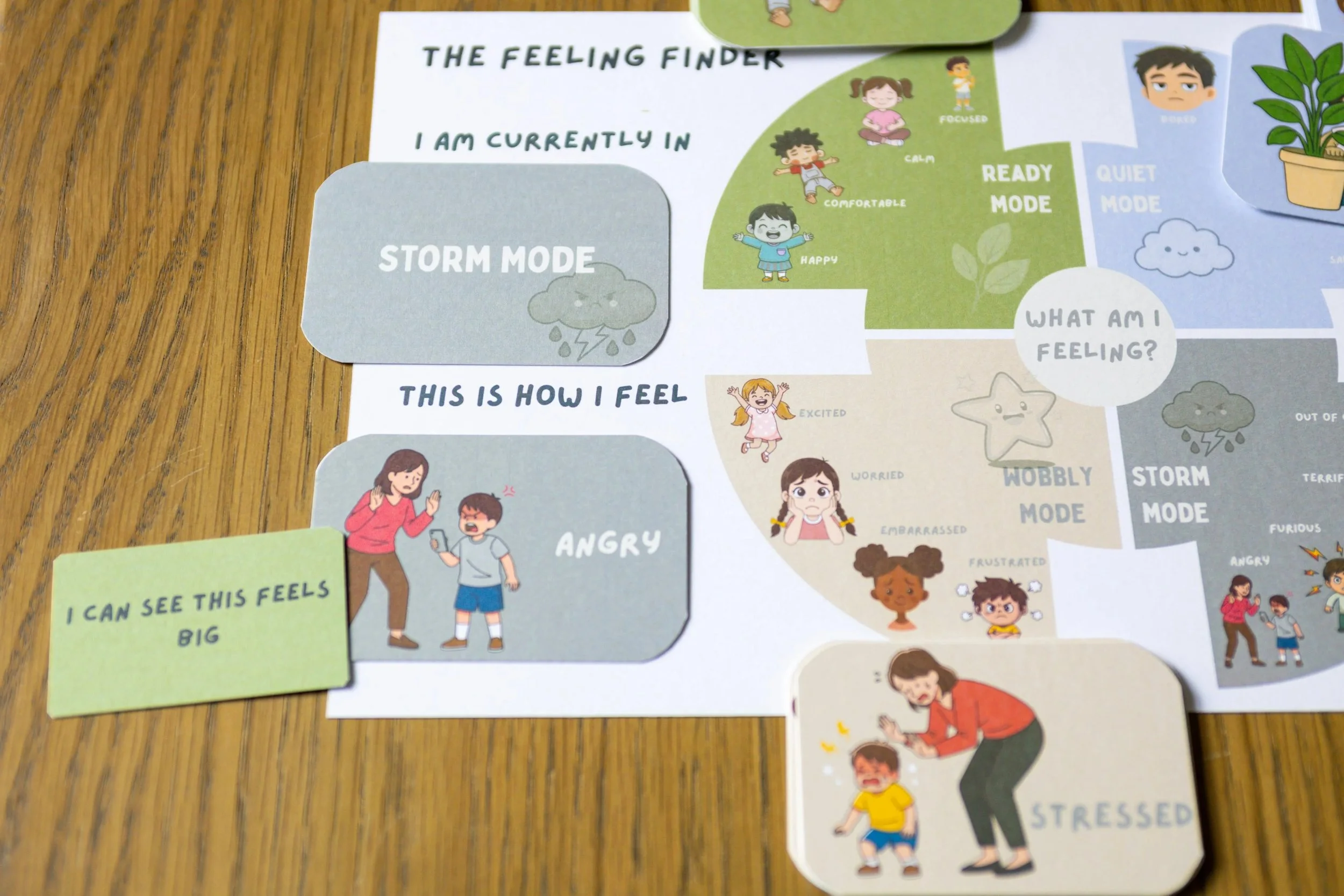
The Feeling Finder
At the centre of the toolkit is the Feeling Finder.
This visual emotional check-in board helps children identify both the emotional mode they are currently experiencing and the feeling that best reflects how they feel.
Rather than asking children to immediately explain complex emotions, the Feeling Finder provides a starting point for reflection and discussion.
Children can use the board during emotional check-ins, classroom wellbeing activities, therapy sessions, nurture groups or supportive conversations at home.
The aim is not to find the "correct" answer. The aim is to encourage emotional exploration and help children begin recognising patterns within their own emotional experiences.
Helping children understand emotions can be difficult — especially when feelings feel big, confusing, or hard to explain.
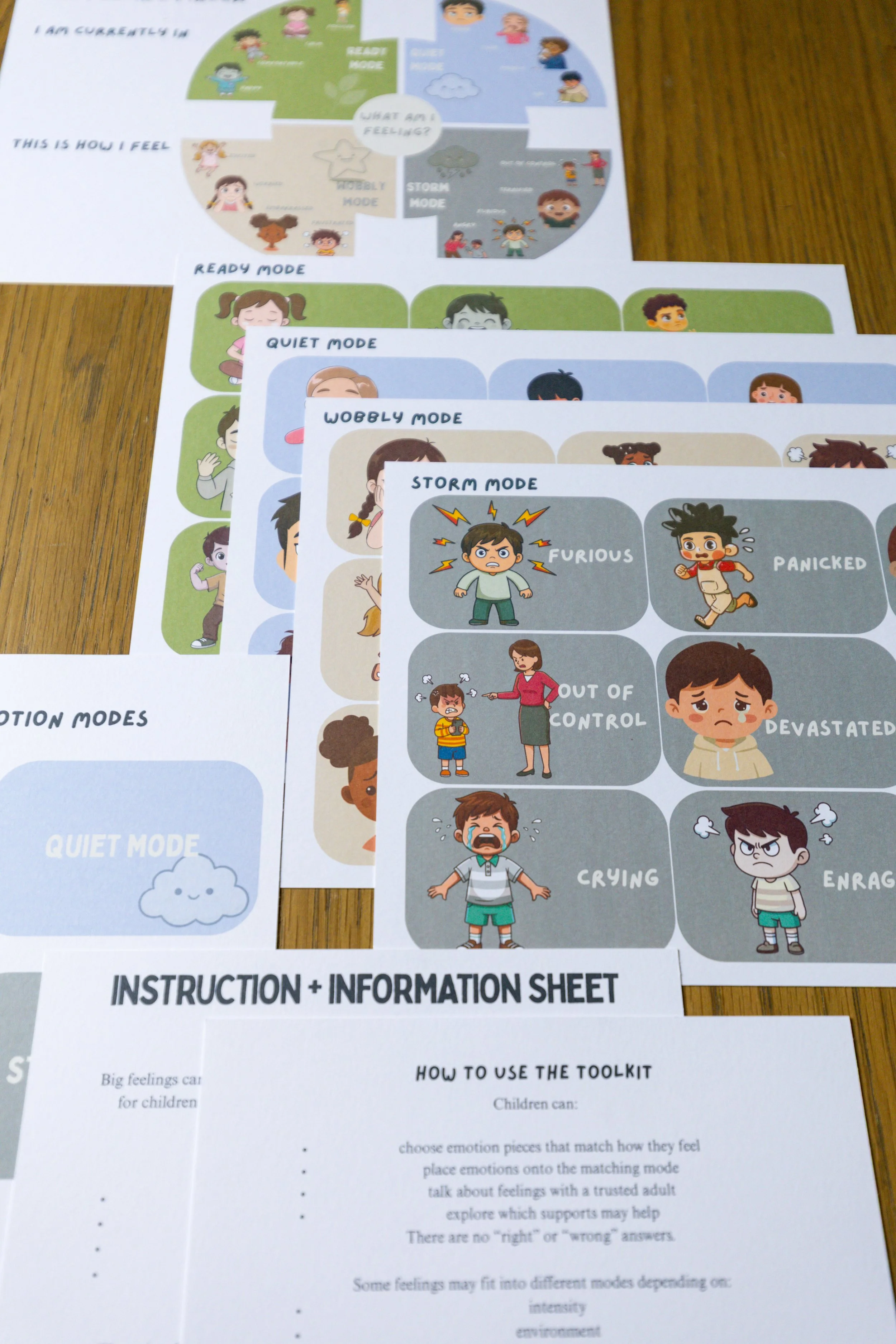
The My Feelings & Modes toolkit has been designed to support children in recognising emotions, identifying emotional states, and beginning meaningful conversations around regulation in a calm, visually supportive way.
Created with neurodiversity-affirming practice in mind, this resource moves away from “good” and “bad” emotions and instead helps children understand that all feelings are okay — different feelings simply need different kinds of support.
Using four simple emotional “modes” — Quiet Mode, Ready Mode, Wobbly Mode, and Storm Mode — children can begin exploring:
how they feel
where those feelings fit
what support may help
Designed for use at home, in classrooms, nurture spaces, therapy settings, and SEND environments, the toolkit supports emotional literacy without becoming overwhelming or overly clinical.
What’s Included
Emotional Modes Circle
4 full pages of colour-coded emotion cut-outs
Quiet Mode emotions
Ready Mode emotions
Wobbly Mode emotions
Storm Mode emotions
“What May Help?” support page
“How I Feel Today” reflection/check-in sheet
Adult guidance sheet
Printable PDF format
Created for
This resource may be especially supportive for:
autistic children
ADHD learners
anxious children
emotionally overwhelmed children
children with sensory processing differences
SEND and ALN settings
emotional literacy work
regulation support
nurture and wellbeing spaces
Why this resource is different
Many emotional regulation resources focus on behaviour.
This toolkit focuses on:
emotional understanding
emotional safety
self-awareness
communication
co-regulation
The visual structure is intentionally calm, simple, and low-demand to reduce overwhelm and encourage repeated use over time.
Perfect for
home regulation routines
calm corners
emotional check-ins
nurture groups
classroom wellbeing areas
one-to-one support
SEND classrooms
pastoral support
therapy and intervention spaces
Important Note
This resource is designed to support emotional awareness and regulation conversations. It is not intended to replace therapeutic or medical support where needed.
This resource is licensed to a single purchaser only. Parents may use the resource within their own household. Teachers may use the resource within a single classroom. Professionals may use the resource within their own practice. Redistribution, resale, sharing, uploading, or rebranding of ThinkaLearn resources is not permitted.
Ready Mode Feelings
Ready Mode represents emotional experiences that feel calm, comfortable and manageable.
The toolkit includes feelings such as:
calm
happy
focused
relaxed
safe
proud
confident
curious
comfortable
These feelings help children recognise emotional states associated with safety, learning, connection and wellbeing.
Many children naturally identify positive emotions more easily than difficult emotions, making Ready Mode an important foundation for emotional awareness.
Wobbly Mode Feelings
Wobbly Mode introduces emotions that often sit between calmness and overwhelm.
These feelings may include:
worried
nervous
frustrated
overwhelmed
restless
embarrassed
confused
stressed
excited
Many children spend significant periods of time moving in and out of these emotional experiences throughout the day.
By learning to recognise these feelings earlier, children can begin understanding emotional changes before they become more intense or difficult to manage.
Quiet Mode Feelings
Quiet Mode explores lower-energy emotional experiences that are often overlooked or misunderstood.
Children are introduced to feelings such as:
tired
lonely
sad
bored
poorly
shy
drained
unmotivated
disappointed
These emotions help children understand that not all difficult feelings appear as anger, frustration or overwhelm.
Sometimes emotional experiences feel quiet, heavy or withdrawn.
Recognising these experiences can help children develop greater emotional understanding and self-awareness.
Storm Mode Feelings
Storm Mode explores emotions that feel powerful, intense or overwhelming.
The toolkit includes feelings such as:
angry
furious
terrified
panicked
devastated
unsafe
crying
enraged
out of control
These feelings can sometimes feel frightening or confusing for children.
By providing visual language for these experiences, the toolkit helps children understand that even the biggest emotions can be recognised, discussed and supported safely.
Understanding That All Feelings Are Valid
A key message throughout the toolkit is that emotional states are not "good" or "bad".
The resource reinforces that every feeling provides information and that emotional experiences naturally change throughout the day.
Children learn that they may move between emotional modes depending on factors such as tiredness, sensory experiences, social interactions, excitement, stress or uncertainty.
This helps reduce shame around difficult emotions and encourages more open conversations about feelings.
Flexible Use Across Home, School & SEND Support
The Emotional Regulation Toolkit has been designed for flexible use across a wide range of settings.
It can be used during:
daily emotional check-ins
classroom wellbeing activities
nurture group sessions
SEND interventions
therapy sessions
one-to-one support
emotional literacy work
family conversations at home
The resource adapts easily to individual children, small groups and whole-class emotional wellbeing activities.
Its purpose is not to label behaviour or force children to identify emotions perfectly.
Its purpose is to help children explore feelings, build emotional vocabulary and develop greater confidence understanding themselves over time.
Adult Guidance & Emotional Conversations
The toolkit includes guidance designed to support parents, teachers and professionals in facilitating emotional conversations.
Adults are encouraged to move away from trying to solve emotions immediately and instead focus on helping children recognise, understand and communicate their experiences.
Supportive prompts such as:
"Thank you for telling me."
"What may help right now?"
"Let's figure this out together."
help create emotionally safe conversations where children feel heard and understood.
Understanding feelings is easier when children feel understood first.
Understanding Feelings Takes Time
Emotional awareness develops gradually over time.
Many children need repeated experiences of emotional safety, supportive conversations and guided exploration before they begin recognising feelings independently. Whilst some children can identify emotions quickly, others may find emotional experiences confusing, overwhelming or difficult to describe for many years.
This is particularly true for children who experience anxiety, autism, ADHD, sensory differences or emotional regulation difficulties. Some children may know they feel uncomfortable but struggle to explain why. Others may recognise strong emotions such as anger or sadness but find more subtle feelings difficult to identify.
Both experiences are completely valid.
Developing emotional awareness is not about teaching children to label every feeling perfectly. It is about helping them build a better understanding of themselves, their experiences and their emotional needs over time.
The Emotional Regulation Toolkit has been designed to support this process gently and without judgement.
Rather than focusing on behaviour alone, the resource encourages children to look underneath the surface and explore the feelings that may be driving their experiences. Through visual emotional modes, feeling identification activities and supportive conversations, children are given opportunities to gradually develop emotional vocabulary, emotional confidence and greater self-awareness.
Over time, children may begin to:
recognise feelings earlier
understand emotional patterns
develop emotional vocabulary
communicate needs more clearly
seek support with greater confidence
build stronger emotional awareness
develop emotional regulation skills more effectively
There is no perfect way to experience emotions.
Children may feel calm, worried, tired, frustrated, overwhelmed, excited, disappointed, angry or joyful at different times throughout the day. Emotional regulation is not about removing those experiences or teaching children that some feelings are acceptable whilst others are not.
It is about helping children understand that all feelings are part of being human.
When children learn to recognise emotions, understand what those emotions may be communicating and feel supported whilst experiencing them, they begin building the foundations for lifelong emotional wellbeing.
Every feeling has a purpose.
Every feeling deserves understanding.
And every child deserves support that helps them make sense of what they are experiencing.
not what you’re looking for?
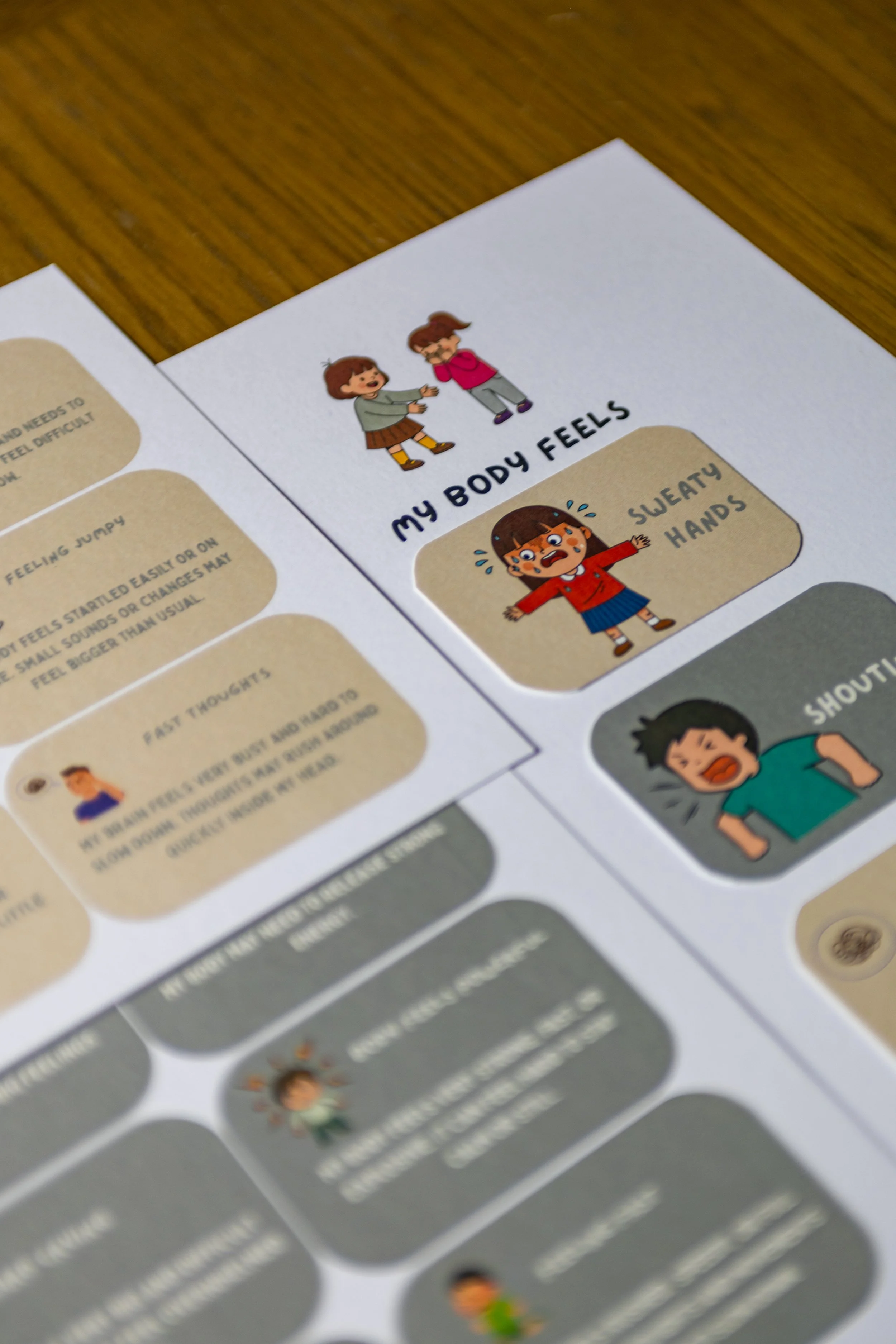
“My Body Feels” is a child-friendly emotional regulation and body awareness resource designed to help children recognise the physical clues their body gives throughout the day.
Many children experience emotions physically before they are able to identify or explain them. This resource helps children begin noticing those body sensations in a simple, visual, and supportive way.
Children explore body clues connected to different regulation states including:
tight chest
wiggly body
feeling fast
hard to focus
heavy body
relaxed muscles
cold hands
tummy flutters
steady breathing
empty tummy feelings
The resource introduces four simple body modes:
Ready Mode
Quiet Mode
Buzzing Mode
Storm Mode
Children learn that bodies can move between different modes throughout the day, and that there are no “bad” body states.
This resource is designed to support:
emotional regulation
interoception
body awareness
sensory understanding
co-regulation
autism support
ADHD support
anxiety support
SEND and ALN interventions
emotional literacy
school and home support
The visual format helps make difficult concepts feel accessible and non-threatening for younger children and neurodivergent learners.
This resource works especially well alongside:
emotional regulation activities
sensory support tools
calm corner resources
Zones-style regulation work
autism and ADHD interventions
SEND classroom support
Included in this resource:
body clue visuals
body mode pages
emotional regulation prompts
matching activities
discussion prompts
information sheets for adults
printable cut-out cards
Perfect for:
parents
schools
teachers
ALN/SEND support
ELSA interventions
autism support
ADHD support
therapy settings
nurture rooms
emotional wellbeing work
Different bodies give different clues.
This resource helps children begin understanding what their body may be trying to say.
This resource is licensed to a single purchaser only. Parents may use the resource within their own household. Teachers may use the resource within a single classroom. Professionals may use the resource within their own practice. Redistribution, resale, sharing, uploading, or rebranding of ThinkaLearn resources is not permitted.
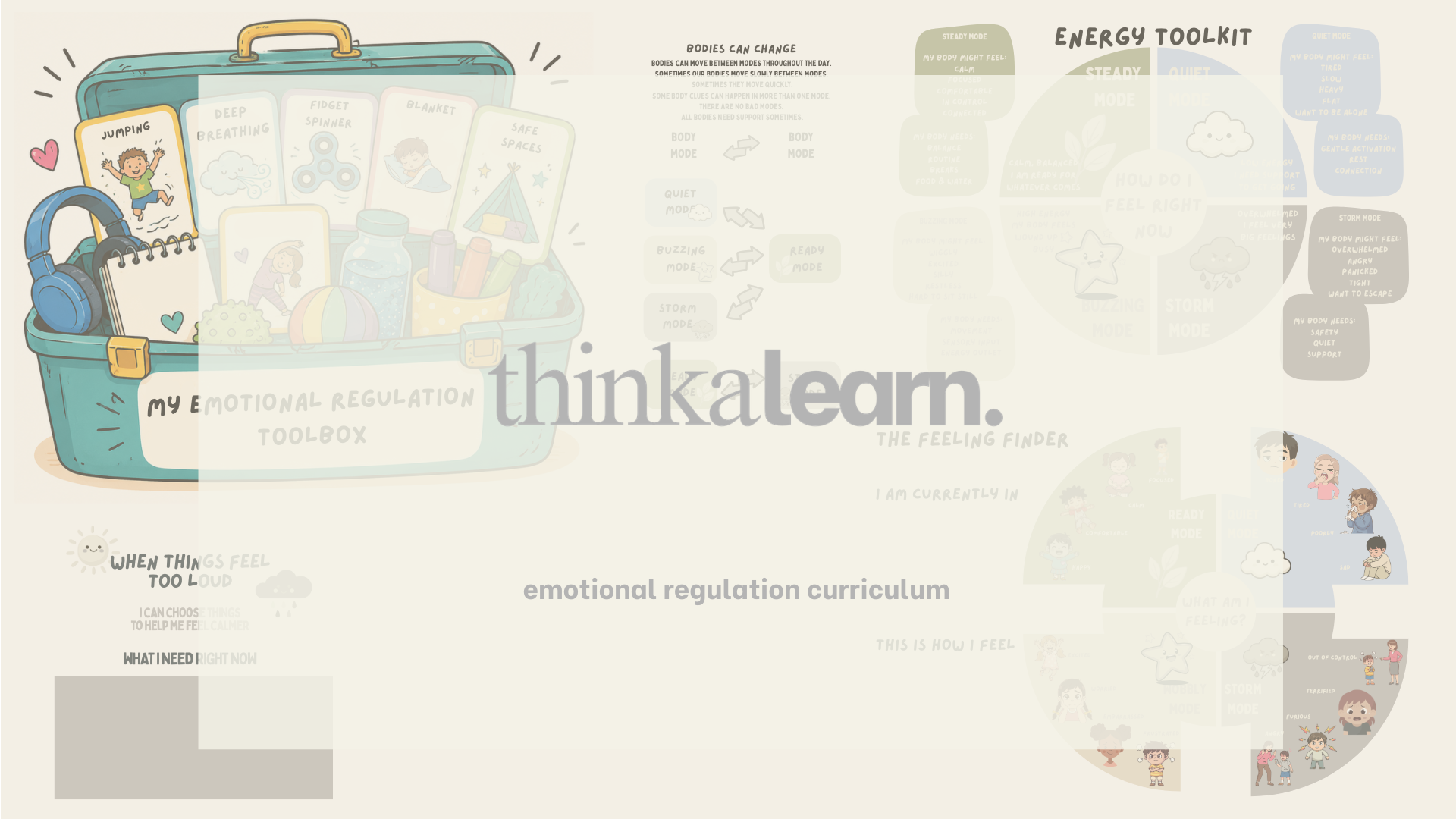
A child-friendly emotional regulation curriculum designed to help children understand their body, emotions, sensory needs, and regulation in a safe, visual, and supportive way.
The ThinkaLearn Regulation Series is a connected set of printable emotional regulation resources created to support children through a step-by-step journey of body awareness, emotional understanding, sensory support, and personalised regulation strategies.
Rather than focusing on behaviour management, the series helps children gradually build awareness of:
overwhelm
body clues
emotional states
sensory needs
regulation tools
supportive strategies
The curriculum follows a simple developmental pathway that helps children move from recognising difficult feelings toward building their own personalised regulation toolkit.
THE FIVE STAGES OF THE THINKALEARN REGULATION SERIES
STAGE 1 — WHEN THINGS FEEL TOO LOUD
Children begin recognising overwhelm, sensory overload, and emotional escalation while exploring calming and safety supports.
STAGE 2 — ENERGY TOOLKIT
Children explore different body and energy states including Ready Mode, Quiet Mode, Buzzing Mode, and Storm Mode.
STAGE 3 — MY BODY FEELS
Children begin recognising physiological body clues and physical sensations connected to regulation states.
STAGE 4 — EMOTIONAL REGULATION TOOLKIT
Children explore different categories of support including calm tools, sensory tools, movement tools, comfort tools, focus tools, and connection tools.
STAGE 5 — MY EMOTIONAL REGULATION TOOLBOX
Children build their own personalised regulation toolkit by identifying tools and strategies that support their individual needs.
DESIGNED FOR CHILDREN WHO MAY EXPERIENCE:
emotional overwhelm
sensory overload
anxiety
autism
ADHD
emotional dysregulation
shutdowns and meltdowns
difficulty recognising emotions
body awareness difficulties
sensory seeking or avoidance
executive functioning challenges
IDEAL FOR:
parents
schools
teachers
nurture rooms
ELSA interventions
therapy settings
autism support
ADHD support
SEND and ALN interventions
emotional wellbeing work
calm corners and regulation spaces
A NEUROAFFIRMING APPROACH
The ThinkaLearn Regulation Series is designed to feel supportive, non-shaming, and child-friendly.
Children are not taught that emotions or body states are “bad.” Instead, the curriculum helps children understand that:
bodies give clues
feelings can change
all children need support sometimes
different tools help different bodies
The visual and accessible format helps children explore emotional regulation in a calm, structured, and supportive way both at home and in educational settings.
The resources can be used individually or together as part of a complete emotional regulation curriculum.
Different bodies need different supports.
This resource is licensed to a single purchaser only. Parents may use the resource within their own household. Teachers may use the resource within a single classroom. Professionals may use the resource within their own practice. Redistribution, resale, sharing, uploading, or rebranding of ThinkaLearn resources is not permitted.
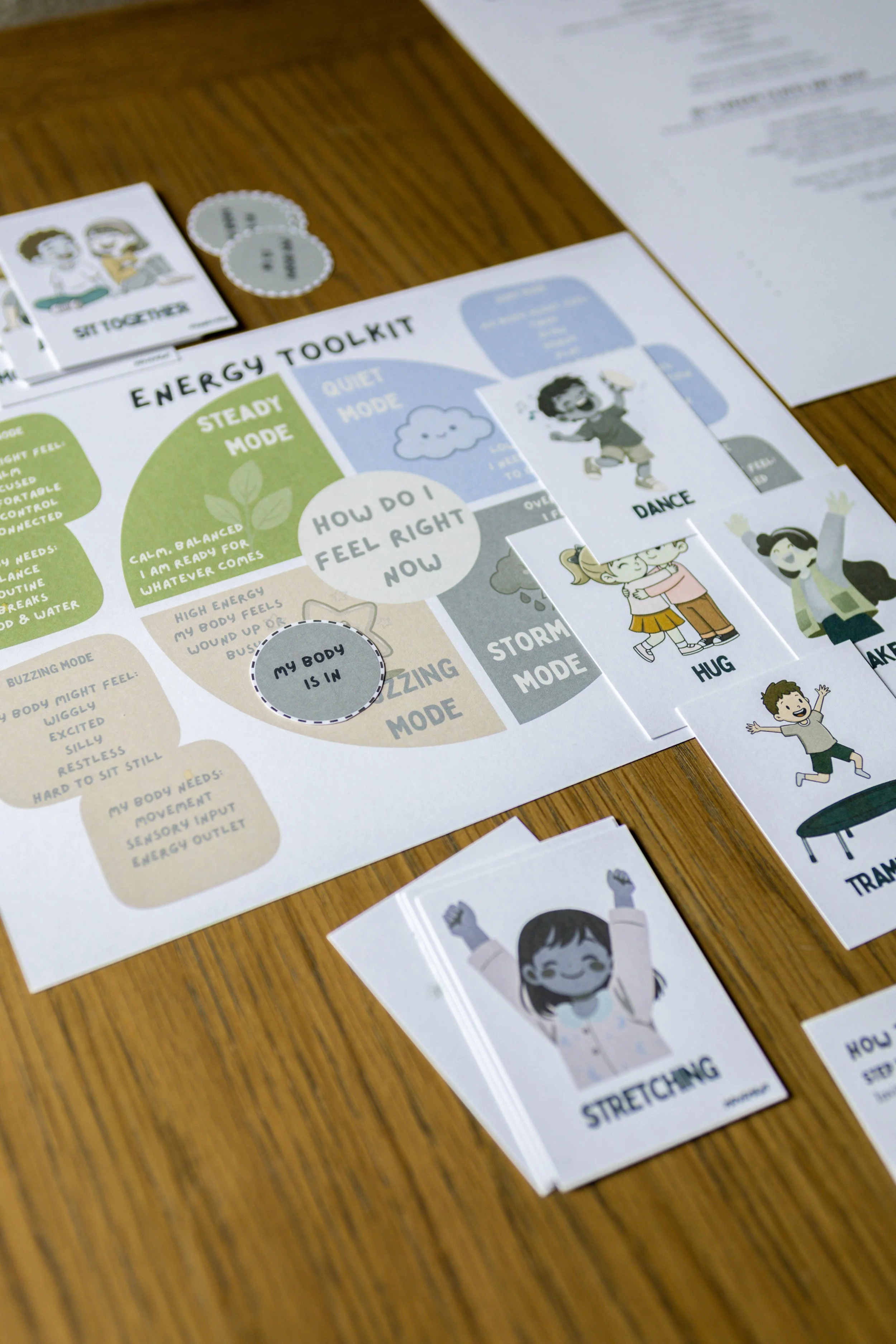
A calm, reusable toolkit designed to help children recognise their energy states, explore body signals, and choose supportive regulation tools in a safe and gentle way.
Created with a neuroaffirming approach, the ThinkaLearn Energy Toolkit helps children build emotional awareness through interactive check-ins, regulation supports, and child-led strategy choices — without shame, behaviour charts, or “good vs bad” emotions.
Designed for home, school, therapy spaces, calm corners, and emotional check-ins.
WHAT’S INCLUDED
Printable Energy Wheel
A reusable emotional check-in wheel helping children identify their current energy state.
Companion Support Cards
Four categories of support tools:
Rest & Reset
Move & Reset
My Sensory Toolkit
Connect & Feel Safe
Instruction & Guidance Sheets
Clear, neuroaffirming guidance for parents, teachers, therapists, and support staff.
Interactive Regulation System
Designed for:
laminating
velcro
dry-wipe use
calm corners
home routines
classroom support
Body Awareness & Emotional Recognition
Helps children begin developing:
interoception
emotional vocabulary
nervous system awareness
self-advocacy skills
This resource is licensed to a single purchaser only. Parents may use the resource within their own household. Teachers may use the resource within a single classroom. Professionals may use the resource within their own practice. Redistribution, resale, sharing, uploading, or rebranding of ThinkaLearn resources is not permitted.